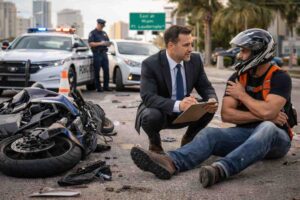



Pedestrians have little physical protection when struck by a car, truck, motorcycle, or other motor vehicle. Even a relatively low-speed impact can cause serious injuries, extended medical treatment, time away from work, and long-term limitations.
Florida law gives pedestrians important rights, but it also imposes traffic duties on pedestrians. After a collision, the legal question is rarely as simple as asking whether the pedestrian or driver had the right of way. Investigators may examine traffic signals, crosswalk location, vehicle speed, visibility, lighting, distraction, roadway design, witness accounts, and the conduct of everyone involved.
This guide explains important issues that can arise after a Florida pedestrian accident and the steps an injured person can take to protect evidence and understand a potential claim.
Florida Drivers Have a Duty to Exercise Due Care
Florida traffic law requires drivers to exercise due care to avoid colliding with pedestrians and people propelling human-powered vehicles.
Drivers must also give warning when necessary and exercise proper precaution when observing a child or an obviously confused or incapacitated person.
This duty is important because drivers control vehicles capable of causing severe injuries to people on foot.
Pedestrians Also Have Traffic Responsibilities
Pedestrians are subject to Florida traffic-control rules. Depending on the location, pedestrians may need to obey pedestrian signals, use sidewalks, yield to vehicles when crossing outside a crosswalk, and follow other roadway requirements.
A pedestrian’s violation of a traffic rule can become part of a negligence analysis, but it does not automatically determine every issue of civil liability.
Crosswalk Rights and Responsibilities
Crosswalk cases are highly fact-specific.
Florida law contains rules governing pedestrians in marked and unmarked crosswalks, pedestrian-control signals, and the responsibilities of approaching drivers.
Evidence that may matter includes
- Whether the pedestrian was inside a marked or unmarked crosswalk.
- The pedestrian signal or traffic light.
- Whether the driver was turning.
- Vehicle speed.
- Whether another vehicle had stopped.
- Visibility and lighting.
- Roadway markings.
- Witness observations.
- Video footage.
Crossing Outside a Crosswalk
Florida law generally requires a pedestrian crossing a roadway at a point other than a marked crosswalk or an unmarked crosswalk at an intersection to yield the right of way to vehicles on the roadway.
That does not give a driver permission to ignore a pedestrian who is visible in the roadway. Drivers still have a statutory duty to exercise due care to avoid a collision.
In a civil claim, both parties’ conduct may be evaluated.
Pedestrian Signals
Pedestrians must obey official traffic-control devices that apply to them.
Signal timing can become critical evidence after an intersection collision. When available, investigators may seek traffic-camera footage, nearby surveillance, witness accounts, or signal-timing information.
Sidewalk Rules
Where sidewalks are provided, Florida law generally directs pedestrians to use them rather than walking on the paved vehicle portion of the roadway unless circumstances require otherwise.
Where sidewalks are not provided, Florida law contains additional rules about walking along a highway, including use of the shoulder when practicable.
Drivers Turning at Intersections
Turning vehicles are a frequent source of pedestrian collisions.
Potential causes include
- Failure to check the crosswalk before turning.
- Looking only for approaching vehicle traffic.
- Turning too quickly.
- Driver distraction.
- Obstructed sight lines.
- Failure to yield when required.
- Poor visibility at night.
Video, witness testimony, signal phases, and vehicle position can be especially important in these cases.
Left-Turn Pedestrian Accidents
A driver making a left turn may be focused on finding a gap in oncoming traffic and fail to observe a pedestrian crossing the destination roadway.
Investigators may examine the driver’s line of sight, traffic signal, pedestrian signal, speed, and whether the pedestrian was already in the crossing path.
Right-Turn Pedestrian Accidents
Right-turn collisions can occur when a driver looks left for vehicle traffic but does not adequately check the crosswalk or sidewalk area to the right.
These cases may involve marked crosswalks, driveway exits, parking lots, or intersections.
Parking Lot Pedestrian Accidents
Pedestrian collisions are not limited to public roads.
Parking lots create conflicts between vehicles and people walking to stores, offices, residences, and parked cars.
Common issues include
- Backing vehicles.
- Limited visibility.
- Distracted driving.
- Pedestrians emerging between parked vehicles.
- Poor lighting.
- Speed within the parking lot.
- Missing or unclear pedestrian pathways.
Driveways and Private Property
A driver entering or leaving a driveway may cross a sidewalk or pedestrian path.
The circumstances of the crossing, visibility, driver attention, and pedestrian position can all affect fault.
Nighttime Pedestrian Accidents
Nighttime collisions often create disputes about visibility.
Investigators may examine
- Street lighting.
- Vehicle headlights.
- Weather.
- Clothing visibility.
- Road design.
- Speed.
- Nearby businesses or signs.
- Whether the driver had enough time and distance to react.
Visibility is a factual issue. A driver cannot necessarily avoid responsibility merely by saying that the pedestrian was difficult to see.
Distracted Driving
A driver using a phone, navigation system, entertainment system, or other device may fail to notice a pedestrian until it is too late.
Phone records, vehicle data, witness testimony, video, and admissions may become relevant depending on the case.
Speeding
Vehicle speed can affect both whether a collision occurs and the severity of the resulting injuries.
Even when a driver is traveling near the posted limit, the circumstances may require additional caution around intersections, schools, crowded areas, poor visibility, or other hazards.
Impaired Driving
Alcohol or drug impairment can seriously affect reaction time, judgment, perception, and vehicle control.
When impairment is suspected, law-enforcement records and testing may become important evidence. Additional legal issues may arise depending on the facts.
Children and Pedestrian Accidents
Florida law specifically requires drivers to exercise proper precaution when observing a child.
Claims involving children can also raise different questions about age, capacity, supervision, school zones, and the reasonable expectations of drivers in areas where children are present.
Blind and Mobility-Impaired Pedestrians
Florida provides additional protections for certain blind and mobility-impaired pedestrians.
For example, special statutory duties apply when a blind pedestrian is using a guide dog or qualifying white cane, and Florida law also imposes stopping and precaution requirements when certain mobility-impaired pedestrians are crossing.
These specialized rules can be important in evaluating driver conduct.
Hit-and-Run Pedestrian Accidents
A driver who leaves the scene can create additional challenges, but the injured pedestrian may still have options.
Useful evidence may include
- Witness descriptions.
- Partial license plate information.
- Vehicle make, model, or color.
- Nearby surveillance video.
- Traffic-camera footage.
- Debris left at the scene.
- Law-enforcement investigation.
- Uninsured motorist coverage when applicable.
Prompt reporting can improve the chances of identifying the vehicle and preserving video.
Call 911 After a Serious Pedestrian Collision
A serious pedestrian collision should generally be reported immediately so emergency medical care and law enforcement can respond.
A police investigation can document the scene, identify witnesses, record driver information, and preserve important initial observations.
Seek Appropriate Medical Care
Pedestrian injuries may involve significant trauma even when the person initially feels able to stand or walk.
Common injuries include
- Traumatic brain injuries.
- Concussions.
- Spinal injuries.
- Fractures.
- Pelvic injuries.
- Knee and leg injuries.
- Shoulder injuries.
- Internal injuries.
- Cuts and road rash.
- Nerve injuries.
- Psychological trauma.
Seek emergency care for severe symptoms and follow appropriate medical advice.
Florida PIP May Apply to Some Pedestrians
Florida Personal Injury Protection coverage can be relevant when a pedestrian is struck by a motor vehicle.
Eligibility and the source of coverage depend on the circumstances, insurance status, household coverage, and applicable statutory rules.
Because PIP issues can be technical, injured pedestrians should not assume that the driver’s liability insurance is the only potential source of benefits.
The 14-Day PIP Medical Treatment Rule
When Florida PIP medical benefits apply, current law generally requires initial services and care within 14 days after the motor vehicle accident.
This is an insurance-benefit rule and should not be confused with the deadline for filing a negligence lawsuit.
People with accident-related symptoms should seek appropriate medical care based on their health needs rather than waiting to see how an insurance claim develops.
Uninsured and Underinsured Motorist Coverage
Uninsured or underinsured motorist coverage may become important if the responsible driver has no bodily injury coverage, insufficient coverage, or cannot be identified after a hit-and-run.
Whether a particular UM/UIM policy covers the pedestrian depends on the policy and facts.
Do Florida Drivers Have to Carry Bodily Injury Liability Insurance?
Florida’s motor vehicle insurance system is different from many states, and not every ordinary vehicle owner is required in every circumstance to maintain the same level of bodily injury liability coverage.
As a result, identifying all potentially available insurance can be particularly important after a serious pedestrian injury.
What Damages May Be Available?
Depending on liability, insurance, injury severity, and applicable law, a pedestrian injury claim may include economic and noneconomic damages.
Economic damages may include
- Past medical expenses.
- Reasonably supported future medical expenses.
- Past lost income.
- Future lost income or reduced earning capacity.
- Rehabilitation expenses.
- Other documented economic losses.
Noneconomic damages may include
- Pain and suffering when legally recoverable.
- Mental anguish.
- Loss of enjoyment of life.
- Permanent impairment.
- Scarring or disfigurement.
The recoverability and amount of damages depend on the facts and governing law.
Wrongful Death Pedestrian Claims
When a pedestrian collision is fatal, Florida’s wrongful death laws may allow qualifying survivors or the estate to pursue certain damages.
Wrongful death cases have specialized rules concerning who may bring the action and what damages may be available.
What If the Pedestrian Was Partially at Fault?
Florida uses a modified comparative-fault system for many negligence claims.
Fault assigned to an injured person can reduce damages proportionally. Under the current statute, a party found more than 50 percent at fault for his or her own harm generally cannot recover damages in negligence actions covered by the rule.
Because pedestrian collisions often involve disputes about crosswalks, signals, visibility, and timing, comparative fault can become a major issue.
Example of Shared Fault
Suppose a pedestrian crosses outside a marked crosswalk while a driver is speeding and looking at a phone.
The driver’s conduct and the pedestrian’s conduct may both be examined. A factfinder could assign percentages of responsibility based on the evidence.
The outcome cannot be determined from a single fact such as where the pedestrian crossed.
Do Not Assume ‘Jaywalking’ Automatically Ends a Claim
Crossing outside a crosswalk can be relevant to fault, but it does not automatically give a driver complete immunity from responsibility.
Florida law still requires drivers to exercise due care to avoid colliding with pedestrians.
The entire sequence of events should be investigated.
What If the Driver Says the Pedestrian ‘Came Out of Nowhere’?
That statement should be tested against objective evidence.
Important questions include
- How fast was the vehicle traveling?
- How far away was the pedestrian when visible?
- Was the driver distracted?
- Was the roadway adequately lit?
- Were headlights operating properly?
- Was anything blocking the driver’s view?
- Where did the impact occur?
- Was braking attempted?
- Is video available?
Evidence to Preserve
Pedestrian accident scenes can change quickly.
Important evidence may include
- Scene photographs.
- Crosswalk and roadway photographs.
- Traffic signals.
- Street lighting.
- Vehicle damage.
- Clothing and footwear.
- Surveillance video.
- Dashcam footage.
- Witness contact information.
- Police reports.
- Medical records.
- Phone or electronic records when lawfully obtained and relevant.
Photograph the Scene
When physically able and safe, photographs can preserve road markings, sight lines, signs, traffic controls, lighting conditions, debris, and the location of the impact.
If the injured person cannot take photographs, a family member, investigator, or attorney may be able to document the area later.
Preserve Surveillance Video Quickly
Businesses, residences, parking facilities, buses, and nearby vehicles may have recorded the collision.
Many systems automatically overwrite footage. Prompt preservation requests can therefore be important.
Keep the Clothing and Personal Items
Damaged clothing, shoes, bags, bicycles, phones, or other items may contain evidence about the impact.
Do not wash, repair, alter, or discard potentially important physical evidence before considering whether it should be preserved.
Document Injuries Over Time
Take clear photographs of visible injuries and keep medical records, treatment instructions, prescriptions, and diagnostic reports.
A factual symptom journal can also help document how recovery changes over time.
Document Lost Income
If injuries prevent work, save pay stubs, employer correspondence, work-status notes, schedules, tax records, and other evidence of lost earnings.
Self-employed people may need additional business records to establish their losses.
Be Careful With Insurance Statements
An insurer may request a recorded statement.
Your obligations may differ depending on whether the request comes from your own insurer or another party’s carrier.
When injuries are serious or fault is disputed, consider legal advice before providing a detailed recorded statement.
Be Careful With Early Settlement Offers
A quick offer may arrive before the full medical picture is known.
Before signing a release, consider whether future treatment, lost income, permanent impairment, and available insurance have been adequately evaluated.
A signed release can permanently resolve claims covered by the agreement.
Social Media After a Pedestrian Accident
Insurance companies may review public social media.
Avoid posting detailed accident accounts, legal conclusions about fault, settlement discussions, or content that could be misunderstood in relation to claimed limitations.
Do not destroy relevant existing content without appropriate legal guidance.
Pedestrian Accidents Involving Commercial Vehicles
When a pedestrian is struck by a delivery truck, rideshare vehicle, bus, company vehicle, or other commercial vehicle, additional parties and insurance policies may be involved.
Potential issues include
- Driver employment status.
- Company responsibility.
- Commercial insurance.
- Vehicle maintenance.
- Driver training.
- Electronic data.
- Delivery or trip records.
Government Vehicles and Public Entities
Claims involving government-owned vehicles, public buses, or dangerous public-road conditions can involve special notice procedures, liability rules, and deadlines.
These cases should be evaluated promptly because ordinary negligence procedures may not be the only rules that apply.
Accident Reconstruction
In a serious or disputed pedestrian collision, an accident reconstruction expert may analyze vehicle speed, braking, impact location, sight distance, roadway evidence, and available electronic data.
Expert analysis is not necessary in every case, but it can be valuable when the parties disagree about how the collision occurred.
Vehicle Event Data
Some vehicles contain electronic information that may help investigators evaluate speed, braking, acceleration, or other pre-impact events.
The availability and usefulness of such data depend on the vehicle and circumstances, and preservation may need to occur quickly.
Common Insurance Defenses
- The pedestrian crossed outside a crosswalk.
- The pedestrian ignored a signal.
- The pedestrian was distracted.
- The pedestrian was difficult to see.
- The driver had no time to react.
- The injuries were preexisting.
- Treatment was delayed.
- Medical care was excessive or unrelated.
- The pedestrian’s own fault caused most of the harm.
Each defense should be evaluated against the actual evidence rather than accepted automatically.
Common Mistakes After a Pedestrian Accident
- Leaving without identifying the driver when physically able.
- Failing to report a serious collision.
- Delaying appropriate medical evaluation.
- Failing to identify witnesses.
- Waiting too long to seek surveillance video.
- Discarding damaged clothing or personal items.
- Giving speculative statements about fault.
- Posting extensively about the accident online.
- Ignoring medical work restrictions.
- Signing a release before understanding the injuries and insurance.
Florida Negligence Filing Deadline
Florida’s current statute of limitations generally provides two years for an action founded on negligence.
Different deadlines, exceptions, accrual rules, wrongful death provisions, or governmental notice requirements may apply depending on the case.
Evidence often disappears long before the legal filing deadline, so early investigation is important.
What to Do After a Florida Pedestrian Accident
- Call 911 after a serious collision.
- Obtain emergency medical care when needed.
- Identify the driver and vehicle if possible.
- Get witness contact information.
- Photograph the scene when safe.
- Preserve clothing and damaged items.
- Seek appropriate follow-up medical care.
- Notify relevant insurers.
- Keep medical bills and records.
- Document missed work and income loss.
- Preserve video promptly.
- Avoid guessing about fault.
- Track claim communications.
- Consider legal advice when injuries are significant or liability is disputed.
When to Consider Speaking With a Florida Personal Injury Attorney
Legal representation may be especially useful when injuries are severe, the driver denies responsibility, the pedestrian is accused of causing the collision, the driver fled, insurance coverage is unclear, a commercial or government vehicle is involved, or long-term damages are expected.
An attorney may help
- Investigate the collision.
- Preserve surveillance and vehicle data.
- Interview witnesses.
- Analyze pedestrian and driver traffic rules.
- Identify available insurance.
- Address PIP and UM/UIM issues.
- Evaluate comparative fault.
- Document medical and wage losses.
- Work with experts when needed.
- Negotiate with insurers.
- Monitor filing and notice deadlines.
- File a lawsuit when appropriate.
Frequently Asked Questions
Do pedestrians always have the right of way in Florida?
No. Florida law gives pedestrians important protections but also imposes traffic duties on them. Right-of-way questions depend on crosswalk location, signals, roadway conditions, and the specific circumstances.
Can I recover if I was crossing outside a crosswalk?
Potentially. Crossing outside a crosswalk can affect fault, but drivers still have a duty to exercise due care to avoid pedestrians. Florida comparative-fault rules may apply.
Can I recover if I was partially at fault?
Potentially. In many Florida negligence cases, damages are reduced according to the claimant’s percentage of fault. Under the current rule, a claimant found more than 50 percent at fault for his or her own harm generally cannot recover in covered negligence actions.
Can a pedestrian receive PIP benefits?
Florida PIP may apply to a pedestrian injured by a motor vehicle depending on the circumstances and available coverage. Coverage questions should be evaluated based on the specific policies and statutory rules.
What if the driver fled?
Report the hit-and-run promptly. Witnesses, surveillance footage, vehicle debris, police investigation, and potentially uninsured motorist coverage may become important.
What if the driver has little or no insurance?
Other sources of coverage may exist, including potentially applicable uninsured or underinsured motorist coverage or coverage associated with another responsible party. The available options depend on the facts and policies.
What if the driver says they could not see me?
Visibility is only one part of the analysis. Speed, lighting, headlights, distraction, sight distance, road design, and the driver’s duty to exercise due care may all be relevant.
Should I keep my damaged clothing?
Yes, if it may be relevant. Preserve clothing, shoes, and other damaged items until you receive appropriate guidance about whether they may be evidence.
How long do I have to file a pedestrian injury lawsuit?
Florida’s current general limitations period for an action founded on negligence is two years, but exceptions and special deadlines can apply.
Pedestrian Rights Depend on the Full Evidence
A pedestrian accident claim should not be evaluated from a single fact such as whether the person was in a marked crosswalk. Florida law imposes responsibilities on both drivers and pedestrians, and the allocation of fault depends on the complete circumstances.
Prompt medical care, scene documentation, witness information, video preservation, insurance analysis, and careful documentation of damages can all become important.
KGD Florida Law can help injured pedestrians investigate a collision, understand Florida traffic and comparative-fault rules, identify potential insurance coverage, preserve evidence, and evaluate a personal injury claim.