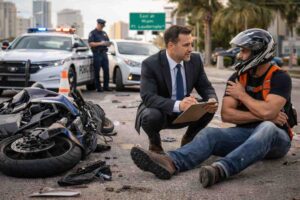



Why Motorcycle Accident Claims Are Different
Motorcycle crashes can produce serious injuries because riders have less physical protection than occupants of enclosed vehicles. At the same time, motorcycle claims can involve insurance and liability issues that differ from ordinary passenger-car cases.
An injured rider may need to investigate the other driver’s negligence, available bodily injury liability coverage, uninsured or underinsured motorist coverage, medical-payment coverage, health insurance, motorcycle-specific coverage, and other possible sources of compensation.
Florida’s Personal Injury Protection system should not simply be assumed to apply to a rider injured while occupying a motorcycle. Coverage depends on the statute, policy, vehicle involved, and circumstances.
Common Causes of Florida Motorcycle Accidents
Motorcycle crashes can occur for many reasons. Determining the cause is important because a personal injury claim generally requires evidence connecting another party’s negligence to the collision and resulting injuries.
- Drivers failing to see a motorcycle before turning left.
- Unsafe lane changes.
- Following too closely.
- Speeding or driving too fast for conditions.
- Distracted driving.
- Failure to yield.
- Impaired driving.
- Running traffic signals or stop signs.
- Opening a vehicle door into a rider’s path.
- Road hazards or construction conditions.
- Defective vehicle or motorcycle components in appropriate cases.
Left-Turn Motorcycle Accidents
A common motorcycle collision scenario occurs when another vehicle turns across the rider’s path. The legal analysis can involve right of way, speed, visibility, traffic controls, signaling, and the timing of each vehicle’s movement.
Do not assume that the location of impact alone establishes fault. Video, witnesses, vehicle damage, roadway evidence, and electronic data can help reconstruct what happened.
Lane-Change and Blind-Spot Crashes
Drivers may fail to detect a motorcycle before changing lanes. Relevant evidence can include turn signals, lane markings, mirror position, witness testimony, dashcam footage, vehicle damage, and the relative position of the vehicles.
Motorcyclists can also face comparative-fault allegations involving speed, lane position, passing, or visibility. Those allegations should be evaluated against the evidence rather than accepted automatically.
Rear-End Collisions
A motorcycle struck from behind can be pushed into traffic, thrown from the bike, or suffer a secondary impact.
Following distance, distraction, speed, road conditions, brake lights, and traffic flow may all matter.
Road Hazards
Potholes, loose gravel, debris, uneven pavement, standing water, construction zones, and other roadway conditions can be particularly dangerous to motorcycles.
Claims involving roadway conditions may raise complex questions about who controlled or maintained the area, notice of the condition, governmental entities, contractors, sovereign-immunity rules, and special notice requirements.
What to Do Immediately After a Motorcycle Crash
- Move to safety if you can do so without creating additional danger.
- Call 911 when emergency assistance is needed.
- Obtain appropriate medical evaluation.
- Report the crash as required.
- Photograph the scene when safe.
- Photograph the motorcycle and other vehicles.
- Identify witnesses.
- Exchange required information.
- Preserve your helmet, riding gear, and damaged motorcycle.
- Avoid guessing about fault at the scene.
Seek Medical Care
Motorcycle injuries can involve the head, spine, chest, abdomen, extremities, skin, and internal organs. Some serious conditions may not be fully apparent immediately.
Medical care is important for health and also creates contemporaneous documentation of symptoms, findings, diagnoses, and treatment.
Potential injuries include
- Traumatic brain injuries.
- Concussions.
- Spinal cord injuries.
- Neck and back injuries.
- Fractures.
- Shoulder injuries.
- Knee and leg injuries.
- Hand and wrist injuries.
- Internal injuries.
- Road rash and skin injuries.
- Scarring and disfigurement.
- Nerve damage.
- Amputations in severe cases.
Head Injuries
A head impact can produce symptoms even when there is no obvious external wound.
Loss of consciousness, confusion, worsening headache, repeated vomiting, seizures, weakness, or other serious neurological symptoms may require emergency evaluation.
Road Rash Is More Than a Scrape
Road rash can range from superficial abrasions to deep injuries involving tissue damage, infection risk, nerve injury, scarring, or the need for surgical treatment.
Photographs taken over time and medical records can help document the progression of these injuries.
Preserve the Motorcycle
A damaged motorcycle can contain important physical evidence about the collision.
Before major repairs, disposal, or destruction, consider whether the motorcycle should be photographed or inspected, particularly when fault is disputed or a possible product defect is involved.
Preserve the Helmet and Riding Gear
A helmet, jacket, boots, gloves, and other equipment can show impact points, abrasion, tearing, or other evidence.
Do not alter or discard potentially relevant physical evidence when litigation is pending or reasonably anticipated.
Florida Helmet Law
Florida law generally requires motorcycle operators and riders to wear compliant protective headgear.
However, a person over 21 may operate or ride without protective headgear if covered by an insurance policy providing at least $10,000 in medical benefits for injuries resulting from a motorcycle crash.
Florida law also generally requires a motorcycle operator to wear an approved eye-protective device, subject to statutory provisions and exceptions.
Does Not Wearing a Helmet Automatically Eliminate a Claim?
No. A helmet issue does not automatically decide whether another driver caused the crash.
Depending on the injuries and circumstances, however, defendants may attempt to argue that protective equipment affected the nature or extent of particular injuries. The legal and medical relevance of such an argument is fact-specific.
Florida PIP and Motorcycles
Florida’s no-fault PIP system is frequently associated with car accidents, but motorcycle cases require a separate coverage analysis.
Florida’s PIP statute extends certain benefits to people struck by an insured motor vehicle while not occupying a self-propelled vehicle. A rider injured while occupying a motorcycle should not assume that ordinary PIP benefits apply in the same way they might for an occupant of a covered passenger vehicle.
Review the actual motorcycle policy and any other potentially applicable insurance.
Insurance Coverage to Investigate
- The at-fault driver’s bodily injury liability coverage.
- Motorcycle bodily injury coverage.
- Uninsured motorist coverage.
- Underinsured motorist coverage.
- Medical-payments coverage if purchased.
- Health insurance.
- Coverage involving an employer when the crash occurred in the course of work.
- Commercial policies when a business vehicle caused the crash.
- Other applicable policies depending on household, vehicle, and policy language.
Bodily Injury Liability Coverage
When another driver is legally responsible, bodily injury liability insurance may provide a source of compensation up to applicable coverage limits.
Coverage should be verified rather than assumed.
Uninsured and Underinsured Motorist Coverage
A serious motorcycle injury can exceed the at-fault driver’s available insurance. Uninsured or underinsured motorist coverage may become important when applicable coverage was purchased and the policy requirements are satisfied.
Policy language, named insured status, exclusions, stacking issues, and other coverage questions can be significant.
What If the Other Driver Has No Insurance?
Lack of liability insurance does not automatically mean there are no legal options, but it can make recovery more difficult.
Potential avenues may include applicable UM coverage, other responsible parties, commercial coverage, or assets, depending on the facts.
Proving Negligence
A motorcycle accident claim generally requires proof of duty, breach, causation, and damages.
For example, a driver may breach a duty by making an unsafe turn, failing to yield, or changing lanes without reasonable care. The claimant must then connect that conduct to the crash and the injuries claimed.
Evidence That Can Help Establish Fault
- Crash-scene photographs.
- Vehicle and motorcycle damage.
- Dashcam footage.
- Traffic or surveillance video.
- Witness statements.
- Crash reports.
- Roadway measurements.
- Traffic-signal information.
- Electronic vehicle data when available and relevant.
- Phone-related evidence when lawfully obtained and relevant.
- Expert accident reconstruction.
Witnesses
Independent witnesses can be particularly valuable when the rider and driver give different accounts.
Obtain names, phone numbers, and email addresses when possible.
Video Evidence
Dashcams, business surveillance systems, homes, traffic systems, and other cameras may capture a crash.
Some systems overwrite video quickly, so preservation efforts should begin as soon as reasonably possible.
Accident Reconstruction Experts
Serious or disputed crashes may require technical analysis of speed, braking, sight distance, impact geometry, roadway evidence, and vehicle movement.
An expert opinion must satisfy applicable evidence standards and should be based on reliable facts and methodology.
Comparative Fault in Florida Motorcycle Cases
Florida’s comparative-fault statute can reduce damages when the injured rider shares responsibility.
Under current Florida law, in negligence actions covered by the statute, a party found more than 50 percent at fault for his or her own harm generally may not recover damages, subject to statutory exceptions.
Because of this rule, even a partial-fault dispute can materially affect the case.
Common Allegations Against Riders
- Speeding.
- Unsafe passing.
- Following too closely.
- Improper lane movement.
- Failure to use lights or signals.
- Distraction.
- Impairment.
- Failure to maintain the motorcycle.
- Conduct that allegedly made the rider less visible.
- Failure to use protective equipment where legally relevant.
An allegation is not proof. Each issue should be tested against the physical evidence, testimony, law, and expert analysis when necessary.
Do Not Assume a Traffic Citation Decides the Civil Case
A citation can be relevant, but civil negligence is a separate legal analysis. The entire body of evidence matters.
Similarly, the absence of a citation does not necessarily establish that no one was negligent.
Damages in a Motorcycle Accident Claim
When liability and causation are established, a motorcycle injury claim may include legally recoverable economic and noneconomic damages depending on the circumstances.
Potential economic damages
- Past medical expenses.
- Reasonably supported future medical expenses.
- Past lost income.
- Future lost income or reduced earning capacity.
- Motorcycle and property damage.
- Other documented economic losses.
Potential noneconomic damages
Depending on the claim and applicable law, noneconomic damages may address pain, suffering, disability, disfigurement, and other nonfinancial consequences.
The availability and proof of damages depend on the type of claim and evidence.
Document Medical Treatment
- Emergency records.
- Hospital records.
- Specialist visits.
- Diagnostic imaging.
- Physical therapy.
- Surgical records.
- Prescription records.
- Work restrictions.
- Future treatment recommendations.
Document Lost Income
If injuries affect work, preserve pay stubs, schedules, tax records, employer verification, work-status notes, and documentation of reduced hours or duties.
Self-employed riders may need invoices, contracts, 1099 forms, tax returns, bank records, and historical earnings information.
Future Medical Care
Severe motorcycle injuries can require rehabilitation, additional surgery, medication, assistive devices, or long-term treatment.
Future medical damages should be supported by qualified medical evidence rather than speculation.
Permanent Injuries
Some riders face permanent physical restrictions, scarring, disfigurement, cognitive changes, or loss of function.
Medical opinions, photographs, vocational evidence, and other documentation may be important when evaluating long-term effects.
Wrongful Death Motorcycle Claims
A fatal motorcycle crash may give rise to a wrongful death claim when another party’s wrongful act, negligence, default, or breach caused the death and Florida’s statutory requirements are satisfied.
Wrongful death claims have specialized rules concerning the personal representative, survivors, damages, and deadlines. Families should obtain advice specific to those rules.
Motorcycle Passengers
An injured passenger may have claims against another driver, the motorcycle operator, or other responsible parties depending on how the crash occurred.
Insurance coverage and comparative-fault questions should be investigated individually.
Commercial Vehicle Crashes
If a truck, delivery van, rideshare vehicle, or other commercial vehicle causes a motorcycle collision, additional parties or insurance may be involved.
Investigation may include
- Driver employment status.
- Vehicle ownership.
- Commercial insurance.
- Company safety records.
- Driver logs when applicable.
- Maintenance records.
- Electronic data.
- Employer responsibility.
Defective Motorcycle or Component Claims
Sometimes a crash or enhanced injury may involve an allegedly defective tire, brake, steering component, helmet, or other product.
Product cases can require preservation of the motorcycle and component, engineering analysis, maintenance records, recall information, and specialized legal evaluation.
Motorcycle Maintenance Records
Keep service and repair records, especially if a mechanical issue is alleged.
Maintenance evidence may help distinguish crash-related damage from a preexisting mechanical problem.
Insurance Adjusters and Recorded Statements
An insurer may request a recorded statement. Obligations can differ depending on whether the insurer is your own carrier or another party’s company.
When injuries are serious or fault is disputed, consider legal advice before giving a detailed statement.
Be Careful With Early Settlement Offers
A quick settlement may be offered before the full medical prognosis is known.
Before signing a release, consider whether treatment is complete, future care is known, wage loss is documented, and all potentially responsible parties and insurance policies have been investigated.
Social Media
Public posts can become evidence. Photographs or videos may be compared with claims about physical limitations or accident circumstances.
Avoid detailed public discussions of fault, injuries, medical treatment, or settlement negotiations.
Do not destroy relevant existing evidence because a claim has begun.
How Long Do You Have to File a Florida Motorcycle Accident Lawsuit?
Florida currently provides a general two-year limitations period for an action founded on negligence.
Different causes of action, governmental defendants, wrongful death claims, coverage disputes, exceptions, and other circumstances can affect deadlines.
Evidence often disappears much sooner than the legal deadline, so investigation should begin promptly.
Government Roadway Claims Can Have Special Rules
When a governmental entity may be responsible for a roadway condition, special sovereign-immunity provisions, presuit notice requirements, limitations, and procedures may apply.
These cases should be evaluated early.
Common Mistakes After a Motorcycle Accident
- Failing to obtain appropriate medical care.
- Discarding the helmet or riding gear.
- Repairing or disposing of the motorcycle before important evidence is preserved.
- Failing to photograph the scene.
- Not collecting witness information.
- Assuming PIP automatically covers motorcycle injuries.
- Accepting an insurer’s fault percentage without reviewing the evidence.
- Giving speculative statements.
- Posting extensively about the crash online.
- Signing a release before the medical and insurance picture is clear.
- Waiting too long to investigate coverage and deadlines.
A Practical Motorcycle Claim Checklist
- Address emergency medical needs.
- Report the crash.
- Preserve photographs and video.
- Obtain witness information.
- Preserve the motorcycle, helmet, and gear.
- Keep medical records and bills.
- Track lost income.
- Identify every potentially applicable insurance policy.
- Request and save insurer correspondence.
- Document symptoms and restrictions.
- Investigate fault and comparative-fault allegations.
- Monitor legal deadlines.
When to Consider Speaking With a Florida Motorcycle Accident Attorney
Legal advice may be particularly useful when injuries are serious, the other driver disputes fault, the rider is accused of being primarily responsible, available insurance is unclear, a commercial vehicle is involved, a roadway defect contributed, or long-term medical and wage losses are expected.
An attorney may help
- Investigate the collision.
- Preserve video and physical evidence.
- Interview witnesses.
- Identify insurance coverage.
- Analyze comparative fault.
- Coordinate qualified experts.
- Document medical and wage damages.
- Evaluate third-party or product claims.
- Communicate with insurers.
- Review settlement offers.
- File litigation when appropriate.
Frequently Asked Questions
Does Florida PIP automatically cover a motorcyclist injured while riding?
Do not assume that it does. Florida’s PIP statute treats coverage involving occupants of self-propelled vehicles differently. A motorcycle accident requires a policy-specific and fact-specific coverage review.
Can I recover if I was partly at fault?
Potentially. Florida comparative fault can reduce damages according to the claimant’s percentage of responsibility. In covered negligence actions, a claimant found more than 50 percent at fault for his or her own harm generally may not recover, subject to statutory exceptions.
Do I have to wear a helmet in Florida?
Florida generally requires compliant protective headgear, but a person over age 21 may ride without it if the statutory medical-insurance requirement is satisfied. Other statutory provisions and exceptions apply.
Does Florida require eye protection?
Florida law generally requires a motorcycle operator to wear an approved eye-protective device, subject to statutory provisions.
What if the driver says they never saw me?
Failure to see a motorcycle does not automatically excuse a driver. The investigation should examine visibility, right of way, lookout, speed, lighting, and the conduct of both parties.
What if the other driver has very little insurance?
Investigate uninsured or underinsured motorist coverage and any other potentially responsible parties or policies. Serious injury claims can exceed a driver’s liability limits.
Should I keep my damaged helmet?
Yes, if it may be relevant. Preserve the helmet and other riding gear rather than discarding or altering them while a claim is being evaluated.
How long do I have to file?
Florida’s current general limitations period for an action founded on negligence is two years, but the correct deadline depends on the claim and circumstances.
Motorcycle Claims Require Early, Careful Investigation
A serious motorcycle crash can involve medical, insurance, liability, and evidence issues at the same time. Riders should not assume that the rules governing an ordinary passenger-car claim apply in exactly the same way.
Preserving the motorcycle and gear, identifying insurance coverage, documenting injuries and lost income, locating witnesses, securing video, and analyzing comparative fault can all affect the outcome.
KGD Florida Law can help injured riders and families evaluate Florida motorcycle accident claims, investigate fault, identify available insurance, preserve evidence, document damages, and understand the legal options available after a serious crash.